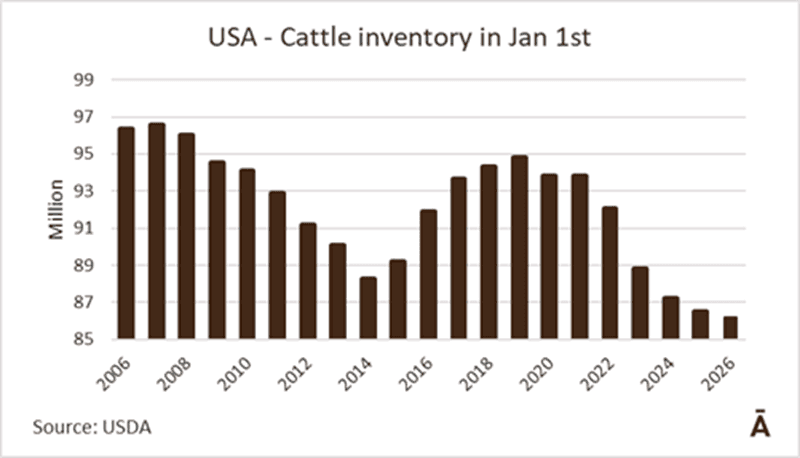
Total cattle numbers continued to decline, confirming that herd rebuilding in the USA remains slow and uneven, according to data published by USDA and reported by Drovers.
As of January 1, 2026, the US cattle and calf inventory stood at 86.2 million head, down 0.35% year-on-year and the smallest total herd since 1951, according to USDA’s annual Cattle Inventory Report. The data confirms that, despite historically strong cattle prices, the industry remains in a prolonged contraction phase.
The beef cow herd declined 1% to 27.6 million head, underscoring that liquidation continued through 2025. Derrell Peel, extension livestock marketing specialist at Oklahoma State University, said the report does not alter the broader trend seen over the past three years, with herd rebuilding progressing at a very gradual pace.
One of the few signals pointing toward future expansion was a modest increase in beef replacement heifers, which rose 1% to 4.71 million head. However, analysts cautioned that this level of retention is insufficient to generate meaningful herd growth in the near term. Patrick Linnell, director of market research at CattleFax, described the report as bullish for prices, noting that while early signs of expansion exist, they remain limited.
Heifer slaughter trends further highlight the slow pace of rebuilding. During 2025, heifer slaughter totaled 9.5 million head, down 7% from the previous year, but still accounted for 52% of heifers weighing more than 500 lb as of January 1, well above levels typically associated with active herd expansion.
Another key takeaway from the report was the sharp contraction in calf production. The 2025 calf crop was estimated at 32.9 million head, down 2% from 2024 and the smallest since 1941. This historically low calf crop is expected to be a central driver of tighter feeder cattle supplies and elevated cattle prices in the coming years.
Looking ahead, Peel expects the combination of a small calf crop and constrained feeder supplies to push cattle and beef prices even higher in 2026. He also emphasized that strong consumer demand continues to support the market, despite higher beef prices relative to competing proteins.
Unlike the rapid herd expansion seen a decade ago, analysts expect the current rebuilding phase to be slow and cautious, shaped by producer risk aversion after past cycles of sharp price reversals.