The contraction of the US cattle herd and restrictions on Mexican cattle imports have deepened the livestock shortage. The potential importation of Argentine beef appears as an alternative to help offset the deficit, though its overall impact would be limited, according to a report from the US Institute of Meat.
Cattle imports from Mexico fell 73% year-on-year in the first half of 2025, sharply reducing the availability of animals for slaughter. The report notes that “this loss of imports occurs at the very beginning of the beef supply chain, leading to higher prices or higher costs within the segment.” In this context, opening the market to Argentine beef could partially ease the shortage of raw material for US processors, particularly for ground beef and industrial beef products. Roughly 50% of all beef consumed in the US is in the form of hamburgers, which depend on a steady flow of imported lean trim.
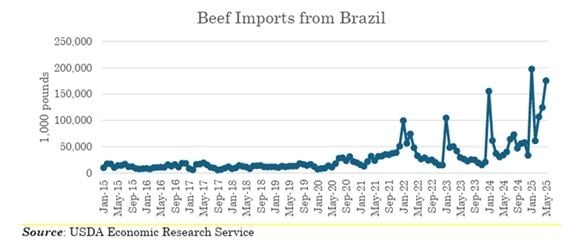
Brazil has long been a key supplier, but its shipments now face a combined tariff of 76.4% following measures imposed since August. By contrast, Argentina’s participation in the “Other Countries TRQ,” with a tariff of only 4.4 cents per kilogram within the quota, could offer a competitive alternative. The structural deficit of cattle stems from historically low herd levels. As of January 1, 2025, the national inventory stood at 86.7 million head —the lowest since 1951— down 8% from 2019. Adding to the pressure are sanitary restrictions following the New World screwworm outbreak in Mexico and the ongoing drought affecting more than 50% of alfalfa acreage.
In parallel, US beef production is projected to fall 4.2% in 2025, while imports are expected to rise 15.7%, according to USDA data. In this context, Argentine beef could serve as a temporary balancing factor rather than a structural solution.
If Argentina fulfills the proposed 80,000-ton quota, its share of US beef imports would rise only from 2% to 5%, which is unlikely to have a significant impact on retail or restaurant beef prices.