Editor: Rafael Tardáguila
rafael@tardaguila.com.uy
The livestock cycle across the Mercosur countries has become aligned and is entering a herd rebuilding phase that will reduce the supply of slaughter-ready cattle, helping to keep the market firm.
This is highly significant for the global beef market, given that Mercosur is the world's largest beef-exporting region.
Although the countries are moving in the same direction, they are not progressing at the same pace. Some are further advanced, such as Paraguay, while in others, particularly Brazil, herd rebuilding is still at an early stage. Brazil's role is especially important given its position as the world's largest beef exporter.
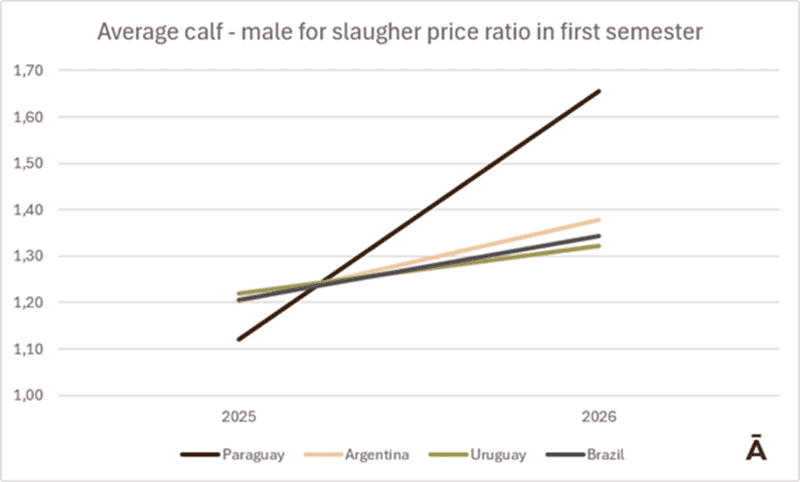
The livestock cycle is closely linked to calf prices and their relationship with slaughter cattle prices. When calves become scarce, their prices tend to rise not only in absolute terms but also relative to finished cattle prices, increasing the replacement ratio.
Comparing the average replacement ratio for the first half of this year with the same period in 2025 shows a widespread increase across the region. The most pronounced change occurred in Paraguay, where the replacement ratio exceeded 1.60 this year. In the other three countries, the ratio increased by about 10 points over the same period, rising from just above 1.20 to more than 1.30.
This regional alignment is largely driven by international market conditions. Signals from export markets have been positive, and beef prices have responded accordingly. This has encouraged producers to retain more breeding females, reducing the supply of slaughter-ready cattle and underpinning cattle prices.
Cow slaughter has been clearly declining in Paraguay and Argentina and has also begun to fall in Uruguay. In Paraguay, slaughter of cows at export plants is at its lowest level since at least 2020. In Argentina, the downward trend has been pronounced, with cow slaughter over the past 12 months falling to the lowest level in four years. Uruguay is lagging somewhat behind, but during the 12 months through June, cow slaughter reached its lowest level in three years and is expected to continue declining.
In Brazil, the trend is still in its early stages, but there are already clear signs of a shift toward herd rebuilding. In Mato Grosso, the country's largest cattle-producing state, female slaughter fell 8% year-on-year during the second quarter.
Ultimately, the favorable international beef market, which has translated into stronger cattle prices, has encouraged producers across the world's leading beef-exporting region to rebuild their herds. This rebuilding phase will reduce the availability of slaughter-ready cattle, lower the proportion of females in total slaughter, and help sustain a firm market for finished cattle.