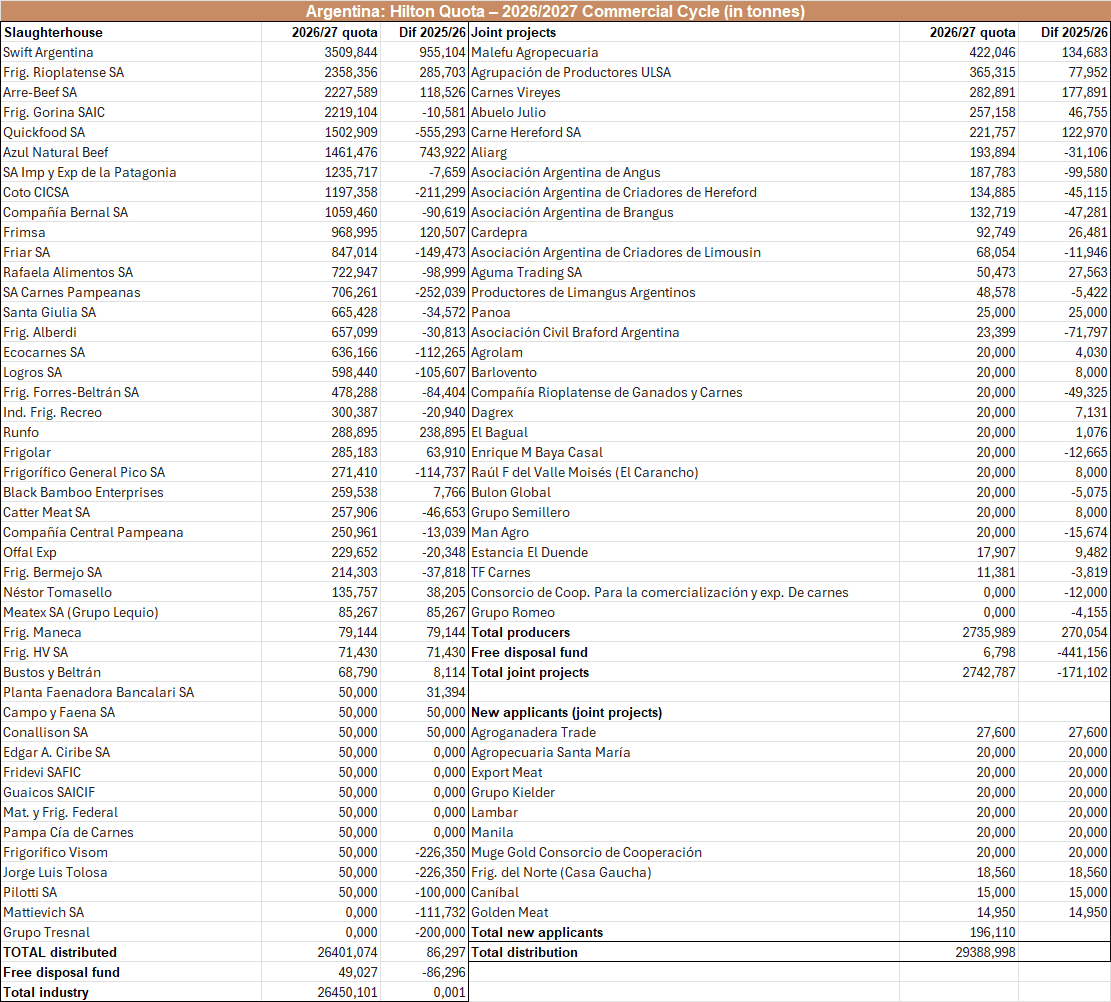
On Monday, the 2026/27 Hilton Quota was allocated under new criteria that, to some extent, allow a greater concentration of the quota among the largest meatpacking companies by eliminating some of the previous mechanisms that favored broader distribution.
Of the 29,389 tons allocated annually to Argentina by the European Union, 26,401 tons were assigned to 43 meatpacking companies, together with an additional 49 tons from the free-disposal reserve. Meanwhile, nearly 2,939 tons were allocated to 37 joint ventures of producer groups, along with 6.8 tons from their own free-disposal reserve.
Under the current allocation, the five largest meatpacking companies received 40% of the total quota, while the top ten accounted for 60.3%.
During the previous 2025/26 cycle, Argentina's quota had been distributed among 40 meatpacking companies and 29 producer groups. The top five companies had received 37.5% of the total allocation, while the top ten accounted for 57.1%.
Thus, while the largest industrial groups increased their share this year, the 10% of the total quota reserved for producer groups was distributed among a larger number of exporters, with ten new producer groups joining the program.
Among the changes introduced to the Hilton allocation criteria was an increase in the maximum share allowed per economic group, from 10% to 15% of the total quota. Under the current allocation, this change benefited only Swift, part of Brazil's Minerva group, which received 955 tons more than last year, bringing its total allocation to 3,510 tons, almost 12% of the overall quota.
At the same time, the volume assigned to the free-disposal reserve was reduced significantly, particularly for producer groups, where it fell from 448 tons to less than 7 tons under the new allocation. For meatpacking companies, the reserve declined from just over 65 tons to 49 tons.
"This free-disposal reserve was generally used by smaller groups that performed well. Because their original quotas were relatively small, if they secured good business they could exhaust their allocation quickly and request additional volume. Now, with very little product available in the reserve, opportunities to grow through that mechanism are very limited," one source said.
However, the reserve is replenished in February using the unfulfilled portion of quota allocations not utilized by the original holders.