
Editor: Andrés Oyhenard
andres@tardaguila.com.uy
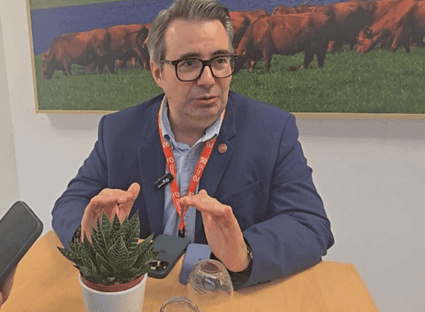
Pablo Domínguez, CEO of ONE Uruguay
Pablo Domínguez, CEO of ONE Uruguay, discusses the current state of global shipping logistics, the impact of the EU-Mercosur agreement, and the generational change at the helm of the Japanese shipping company.
Pablo Domínguez has spent 32 years in the shipping industry. He began his career on the Europe trade lane—the very route that has now returned to the center of attention—and since then has witnessed everything from booms and crises to pandemics and global disruptions that once seemed unimaginable. Today, he is CEO of ONE Uruguay, the local subsidiary of Ocean Network Express, the Japanese shipping company that operates one of the world's largest container fleets.
His conversation with World Beef Report (WBR) comes at a particularly significant moment. The conflict in the Middle East has reshaped global shipping routes and absorbed all available vessel capacity. The European Union-Mercosur agreement has finally come into force after decades of negotiations. And this week, ONE announced a leadership transition: 47-year-old Till Ole Barrelet has taken over as Global CEO, succeeding Jeremy Nixon, who had led the company since its founding in 2018.
How would you describe the current state of global shipping logistics?
It's an extraordinary situation. Under normal circumstances, historically, between 2% and 4% of the global fleet would be idle because there simply wasn't enough demand. Today, that no longer exists. There are no ships available. The conflict in the Middle East lasted far longer than anyone expected, forcing many shipping services to avoid the Suez Canal. That completely reshaped global trade routes, especially between Asia, Europe, and the United States. Every idle vessel was brought back into service. On top of that, demand has remained strong. As a result, we're facing a significant bottleneck, particularly in Asia. Chinese ports are congested, vessel capacity is stretched to its limits, and difficult weather conditions—fog and storms—have created additional delays. We experienced that ourselves recently in Montevideo: when the Coast Guard closes the port because of fog, nothing can enter or leave for safety reasons.
And what about container availability?
Fortunately, that's much better than during the pandemic. Back then it was a disaster. Containers ended up in destinations where they weren't supposed to be, and we had no empty boxes available for exporters. After that experience, shipping companies invested heavily in expanding container fleets. ONE made a significant investment as well, not only renewing its fleet but also increasing the number of available containers. So, although today's situation is also very challenging, we're much better prepared than we were in 2020 and 2021.
Are new ships being built to respond to this excess demand?
Yes, although ordering a new vessel is far from a simple decision. First, you need to secure a slot at a shipyard, and from that point until delivery usually takes around four years, based on my experience. Most shipyards are in China, South Korea, and Japan. Chinese yards have shortened construction times considerably, but it's still a lengthy process. The risk is obvious: you decide to build today because demand is high, and by the time the ship is delivered, market conditions may have changed completely. That's why people say you must be a sailor to truly understand this business.
What is clear is that all new vessels are now being designed with alternative fuels in mind. Methanol, for example. In fact, this week Brazil is coordinating the first ethanol bunkering operation for a vessel. In other words, the use of non-fossil fuels in maritime transport is no longer a future concept—it's already happening.
And what about green hydrogen? Uruguay has a project that appears close to moving forward.
I certainly hope it does. Japan is one of the partners involved in that project, and I believe it would be extremely important—not only for Uruguay but also for us as a shipping company. Having the ability to bunker alternative fuels in Uruguay would add tremendous value to the Port of Montevideo.
What is happening with freight rates? Oil prices have fallen sharply. Is that being reflected in shipping costs?
The market adjusts overtime, but not immediately. Right now, import freight rates are under upward pressure because of the excess demand I mentioned earlier. And lower oil prices haven't yet been fully reflected in freight rates because shipping companies don't buy fuel the way we fill up our cars at a gas station. They operate with long-term fuel hedging contracts. So, the adjustment eventually comes, but not overnight.
The EU-Mercosur agreement has entered into force. How is the shipping industry viewing it?
I'm genuinely excited about it. The Europe trade lane was the first one I worked on 32 years ago, and it's the one I know best. What we're seeing today is a very positive environment, genuine enthusiasm, and solid demand for shipments to Europe. Volumes haven't jumped dramatically yet, but growth is steady and continuous. At ONE, we're encouraging our headquarters to prepare for this opportunity, because Uruguay is making a serious commitment to Europe and we need to be ready—with containers, reefer plugs, and sufficient capacity. Europe is a particularly demanding trade lane because that's where you move the largest volumes of chilled beef, which is much more sensitive than frozen products. It requires special care. It's unfortunate that after waiting so many years for this agreement, it arrived rather suddenly and didn't leave us much time to prepare. But that's exactly what we're doing now.
And what about the United States, where beef supplies remain very tight?
We're seeing extremely strong and dynamic demand. However, ONE doesn't have as much capacity on that trade lane as it does to Europe or China, so our participation is more limited. We're closely monitoring the market because we'd like to expand our presence there in the future.
ONE also announced an important leadership change recently.
Yes. Just last week ONE announced a major global leadership transition. Jeremy Nixon, who had served as CEO since the company's founding in 2018 and is highly respected throughout the industry, stepped down. He has been succeeded by Till Ole Barrelet, a 47-year-old German executive with extensive experience in the shipping sector. ONE is embracing generational renewal, and we're very optimistic about this new chapter.
