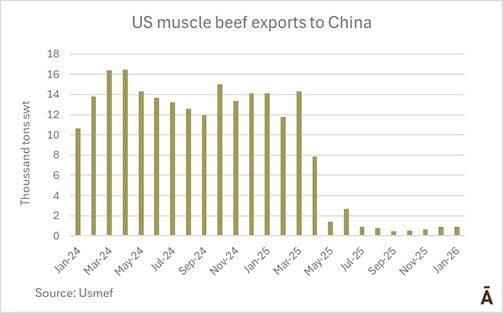
US beef exports totaled 92,558 tons in January, down 10% year-over-year, though export value declined only 3% to US$ 780,1 million, reflecting higher average prices. Beef muscle cut exports were down in 12 thousand tons to 65,047 for US$ 654 million. Volume was down 16% in the annual comparison, while value fell 9%.
According to the United States Meat Export Federation (Usmef), export prices are still not reaching their full potential while China remains largely absent from the market. Excluding China from the January figures, exports rose 5% in volume and 16% in value.
Shipments increased year-over-year to Korea, Japan, Taiwan, the Caribbean, ASEAN and South America, while export value also improved in Mexico, Canada and Central America.
Exports of beef variety meats stood out in January, reaching 27.511 tons, 6% above a year earlier, while export value jumped 46% to a record US$ 126 millions. According to USMEF president and CEO Dan Halstrom, the strong demand for variety meats is especially important in a context of tight cattle supplies. Much of the growth was driven by shipments of tongues and skirts to Japan, although demand strengthened across a broad range of markets.
Shipments of variety meats to Japan surged 88% year-over-year to 6.137 tons, with export value rising 84% to US$ 54,7 millions. Exports also increased to Korea, Taiwan, Peru, Chile and South Africa, while shipments to Mexico declined slightly in volume but still posted higher value. Total US exports of beef and variety meats to Japan reached 19.956 tons, up 5%, with value increasing 7% to US$ 149,5 million.
Demand from Taiwan also showed strong growth, with shipments totaling 5.631 tons valued at US$ 63 million, increases of 79% in volume and 63% in value compared with January 2025. Meanwhile, exports to Korea, the largest value market for US beef, reached 19.482 tons, up 4%, with export value rising 6% to US$ 192,6 million. January also marked the first month in which US beef entered Korea duty-free under the Korea-US Free Trade Agreement, after tariffs gradually declined from the pre-FTA level of 40%.