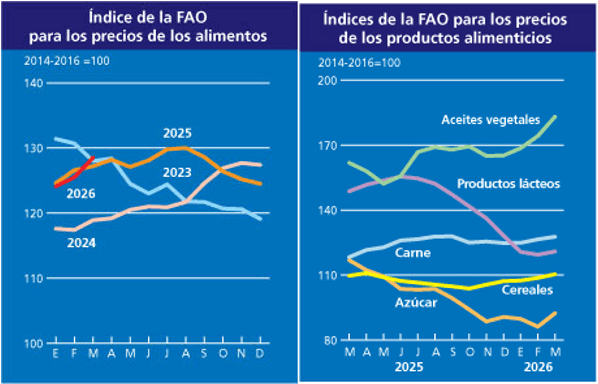
FAO Meat price index rose 1% in March
The FAO Meat Price Index averaged 127.7 points in March, up 1.2 points (1%) from February and 9.4 points (8%) above its level a year earlier. The increase was mainly driven by higher pork prices, along with a modest rise in beef quotations, while sheep and poultry prices declined.
Pork prices surged, supported by stronger quotations in the European Union amid seasonal demand.
Global beef prices also increased, led by Brazil, where tight cattle supply reduced export availability in a context of solid global demand; this was partially offset by stable prices in Australia, supported by ample supply.
By contrast, sheep meat prices declined due to higher exports from New Zealand, although firm prices in Australia—backed by steady demand in key markets—partially mitigated the drop, despite higher tariffs imposed by the United States and logistical constraints affecting access to Middle Eastern markets.
Global poultry prices edged lower, reflecting weaker quotations in Brazil amid abundant supply and steady import demand, with shipments to key Middle Eastern destinations being rerouted through the Red Sea.
The FAO global food price index averaged 128.5 points in March 2026, up 3.0 points (2.4%) from the revised February level, marking the second consecutive monthly increase. Price indices for all commodity groups—cereals, meat, dairy products, vegetable oils, and sugar—rose to varying degrees, driven not only by underlying market fundamentals but also by reactions to higher energy prices linked to the escalation of the conflict in the Middle East.