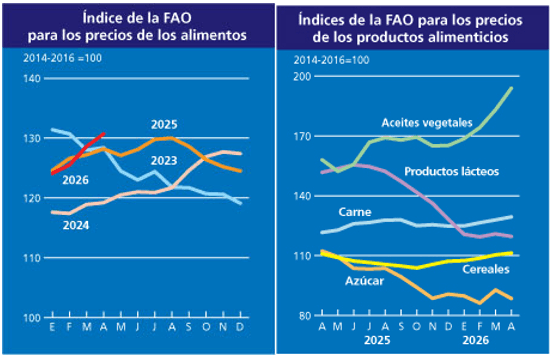
The FAO Meat Price Index averaged 129.4 points in April, up 1.6 points (1.2%) from March and 7.8 points (6.4%) above the level recorded a year earlier. As a result, the index reached a new all-time high.
The increase was driven by higher prices across almost all categories, with the sole exception of sheep meat, which ended the month broadly unchanged. Beef set the tone: export quotations in Brazil rose again, pressured by tight supplies of slaughter-ready cattle — reflecting the ongoing herd rebuilding process — and by firm international demand, particularly from China, where import quotas available under the new three-year safeguard scheme are being filled at a strong pace.
Pork prices also improved, although more moderately. Quotations in the European Union gained ground on stronger seasonal demand, but the effect was partially offset by lower prices in Brazil, where supplies remain ample.
In poultry, the boost once again came from Brazil: strong buying interest from several African markets more than compensated for weaker sales to the Near East, a region where logistical restrictions continue to force shipments to be rerouted through the Red Sea.
Sheep meat, meanwhile, ended virtually flat. Higher quotations in Australia — supported by limited exportable supplies — were offset by declines in New Zealand, where demand from China, its main destination, weakened.
The FAO Food Price Index averaged 130.7 points in April 2026, up 2.1 points (1.6%) from the revised March level, marking the third consecutive monthly increase, although at a slower pace than in the previous month. Price indices for vegetable oils, meat and cereals increased to varying degrees, offsetting declines in sugar and dairy prices. Compared to historical levels, the April index stood 2.5 points (2.0%) above its value a year earlier but remained 29.6 points (18.4%) below the peak reached in March 2022.