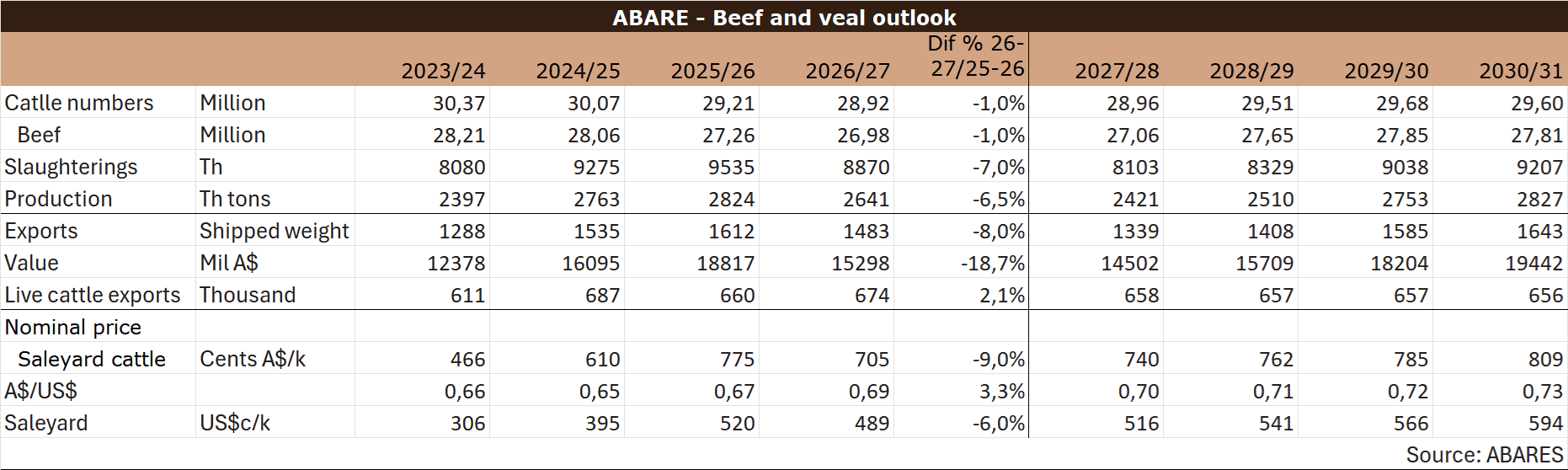
Australian cattle prices point lower in 2026/27 despite lower production
Australia’s beef sector faces an unusual scenario for 2026/27: declining production alongside downward pressure on cattle prices.
According to the latest ABARES report, beef production in Australia is projected to fall 6% year-on-year to 2.6 million tons, driven by lower slaughter.
However, this supply adjustment is not expected to support prices. A key factor is weaker demand from processors, facing tighter margins and reduced competition for cattle. ABARES projects an average cattle price of A$ 7.05/kg, a 9% annual decline. In US dollar terms, an appreciation of the Australian dollar would limit the drop to 6%, to around US$ 4.89/kg.
For 2026/27, ABARES also notes that trade restrictions —such as Chinese safeguard measures— will limit exports and increase pressure on other markets, weighing on global prices.
On the production side, climatic conditions play a key role. Persistent dry conditions in several regions are expected to keep cattle supply elevated (particularly cows), reducing processor competition and putting downward pressure on prices.
In addition, herd rebuilding will be limited. The cattle inventory is projected to remain broadly stable (-1%), after several years of high female slaughter that reduced the breeding base.
In this context, the market presents an unusual dynamic: despite lower production and exports (-8%), the balance between available supply, processor demand and trade restrictions points to weaker prices in 2026/27.
Looking further ahead, ABARES projects that production and exports will recover toward the end of the decade, with shipments again exceeding 1.6 million tons by 2030/31. Prices are also expected to rise, with projections pointing to an increase of more than 20% in US dollar terms by that time.