Although the situation is not uniform across processing plants, a significant portion of Uruguay’s beef industry is currently covering a large share of its cattle requirements with animals coming from company-owned and third-party feedlots, many of which had not yet been priced. “Today, feedlot cattle are the main driver of price formation,” a market operator told WBR.
According to the source, several plants are showing interest almost exclusively in high-quality grass-fed cattle. “They may open a spot here and there,” he said, but for more standard cattle it is becoming increasingly difficult to secure prompt delivery slots. While some processors lacking sufficient feedlot supplies are still offering slaughter schedules within four to five days, others have already secured much of their slaughter needs through the first two weeks of July.
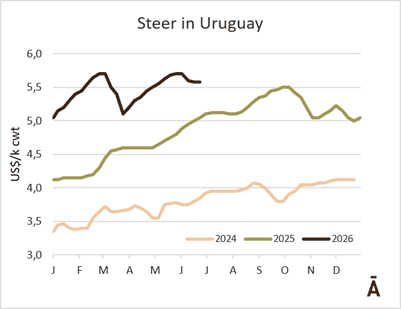
In this environment, heavy, high-quality steers continue to achieve prices of up to US$/kg 5.60 carcass weight, while for the bulk of the available supply without those characteristics “it is difficult to reach US$/kg 5.50,” the source said. The cow market also shows considerable dispersion: top-quality cows reach US$/kg 5.25, heavy cows trade between US$/kg 5.15 and 5.20, and less finished cows are quoted around US$/kg 5.00-5.05, currently the most abundant category on the market.
Sources agree that winter pastures have lost productivity in recent weeks, which has started to translate into a somewhat larger supply of grass-fed cattle. At the same time, heifers remain one of the most sought-after categories. The domestic market is paying up to US$/kg 5.50 carcass weight, while exporters are offering up to US$/kg 5.45. Both are competing strongly with feedlots, which are looking for lighter animals to fill their feeding programs.
For now, the prevailing view is that processors are in a relatively comfortable position to supply their plants and slaughter schedules thanks to the significant contribution of feedlot cattle and the appearance of somewhat more grass-fed cattle compared with previous weeks.