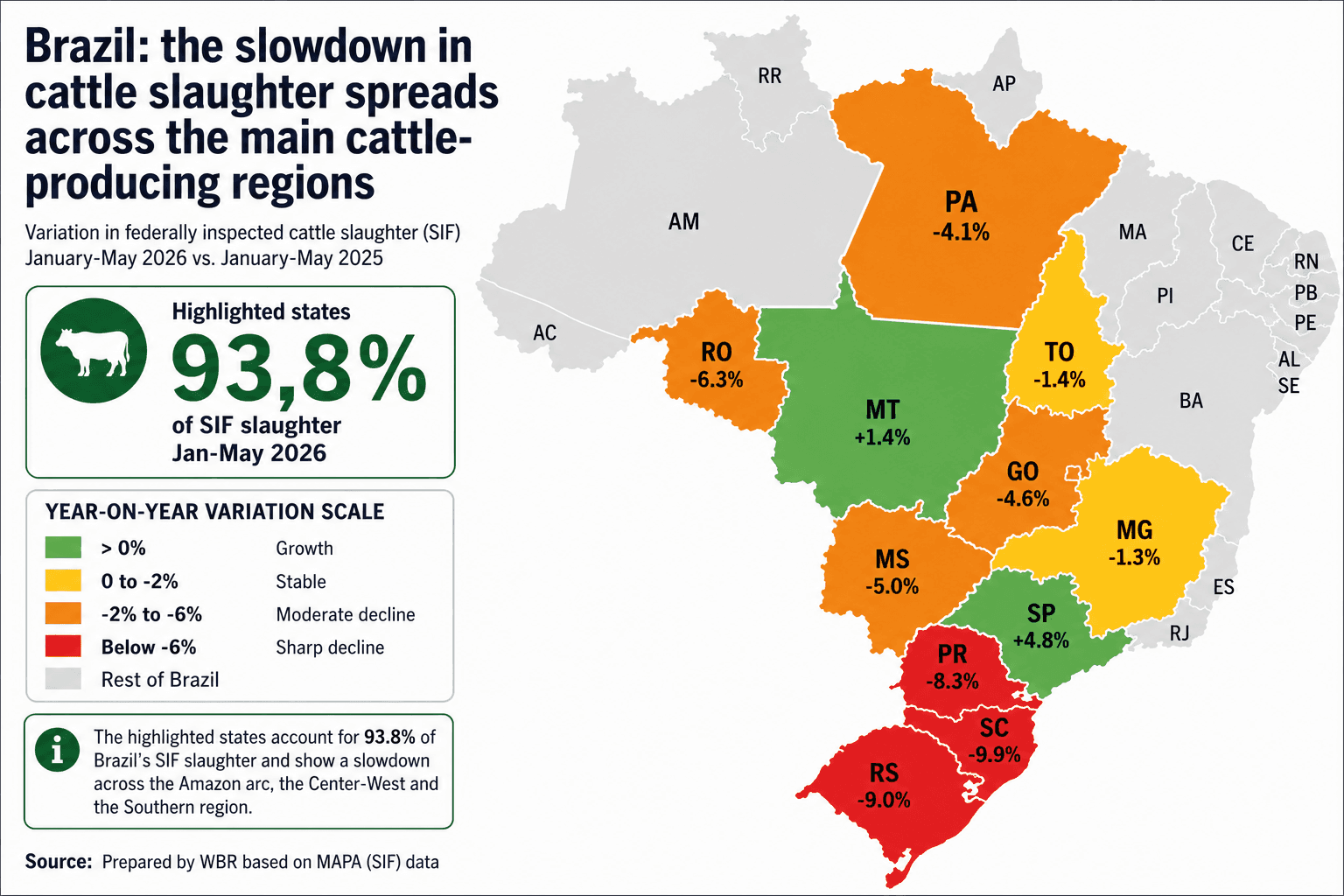
Cattle slaughter in federally inspected plants (SIF), which account for Brazil’s export-oriented industry, totaled 11.81 million head between January and May, down 2.3% from the same period in 2025. However, behind this moderate overall decline, a clear regionalization of cattle supply is beginning to emerge, with reductions concentrated in some of the country’s main producing areas.
The decline in slaughter activity is starting to confirm the anticipated shift in the cattle cycle toward a contraction phase in supply, driven by a reduction in female slaughter.
The states highlighted on the map account for 93.8% of Brazil’s total SIF slaughter. The most significant signal is that the slowdown has already reached the so-called Amazon arc, one of the regions that led Brazil’s cattle expansion in recent years. Slaughter fell 4.1% year-on-year in Pará, 6.3% in Rondônia and 1.4% in Tocantins.
Signs of adjustment are also emerging in the Center-West, the country’s main cattle-producing region. Goiás (-4.6%) and Mato Grosso do Sul (-5.0%) posted significant declines, while Mato Grosso continues to expand and remains the major exception, with slaughter increasing 1.4% from a year earlier. The performance of Mato Grosso is particularly relevant given that it is Brazil’s largest cattle-producing state and one of the main suppliers of cattle to the export industry.
The South shows the most uniform contraction pattern. Slaughter declined 8.3% in Paraná, 9.9% in Santa Catarina and 9.0% in Rio Grande do Sul, making it the regional block with the steepest percentage declines in the country.
In contrast, São Paulo has consolidated its position as the main exception alongside Mato Grosso. SIF slaughter increased 4.8% year-on-year, the strongest growth among Brazil’s major cattle-producing states.
In absolute terms, the largest contributions to the national decline came from Rondônia, Mato Grosso do Sul, Goiás and Pará, which together reduced slaughter by more than 270,000 head compared to January-May 2025. São Paulo and Mato Grosso partially offset that decline with a combined increase of nearly 92,000 head.
Beyond the relatively moderate reduction in national slaughter, the geographic distribution of the data suggests that the slowdown in cattle supply is already spreading across a large share of Brazil’s main cattle-producing regions, although pockets of growth remain in key states such as Mato Grosso and São Paulo.