Editor: Andrés Oyhenard
andres@tardaguila.com.uy
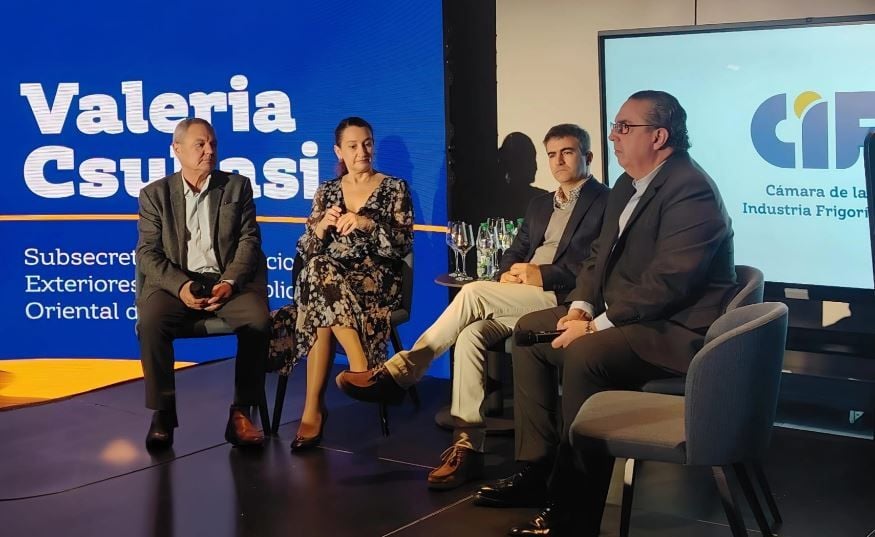
The Uruguayan Meat Industry Chamber (CIF) marked the 150th anniversary of the first chilled beef shipment with a conference focused on the challenges and opportunities facing the country’s beef chain. The event was held at Distrito El Globo and brought together leading figures from the public and private sectors.
Participants included Deputy Foreign Minister Valeria Csukasi, Frigorífico Las Piedras director Alberto González, MBRF CEO Marcelo Secco, and UCU Business School dean Marcos Soto. The event concluded with a tribute to Daniel Belerati, who chaired CIF for 25 years.
More cattle and fewer regulations
The need to increase cattle production was a recurring theme throughout the discussion. Secco argued that Uruguay’s meat cluster still faces pending reforms in labor, production, and commercial areas.
“We would like to have more raw material and fewer regulations. Uruguay has taken on sanitary commitments that are limiting that growth,” the MBRF executive said.
González echoed that concern and used a striking phrase to illustrate the issue. “We have 1.7 million tourist cows — the ones we don’t have,” he said, referring to the gap between the country’s 4.7 million breeding cows and the 3 million calves produced annually.
In his view, live cattle exports have not changed that reality. “It’s been four years since live exports took off and an entire generation has passed, yet we haven’t increased the supply of raw material,” he said.
Untapped potential
CIF president Daniel Urgal quantified the opportunity. “We could process 1 million additional head per year. If we produced that extra million head, it would generate nearly 40,000 new jobs,” he said.
He also raised a question that resonated throughout the event: “What industrial role do we want for our country? We can decide that ourselves; otherwise, others will decide it for us, and it will not be to our benefit.”
From a competitiveness perspective, Soto highlighted the role of technology and the growing appreciation for animal protein. “There are very strong trends, and one of them is the renewed value consumers place on animal protein in demanding markets. That is the niche where Uruguay competes,” he said. He also expressed optimism regarding the competitiveness bill expected to be submitted to Parliament by the Ministry of Economy and Finance.
A historic opportunity
Csukasi delivered the most optimistic assessment of the international environment. Referring to the current state of global trade, she summarized it with the phrase: “In troubled waters, fishermen prosper.”
She argued that Uruguay faces a historic opportunity through a series of trade agreements, including the EU-Mercosur deal, EFTA, Canada, a potential accession to the Trans-Pacific Partnership, and possible future progress toward the RCEP.
“If in the next two years we go from having tariff preferences covering 30% of global trade to more than 80%, how will we respond if we don’t have enough beef?” she asked. “Sometimes people around the world tell me that all Uruguayan beef is already sold.”
González offered a historical perspective on Uruguay’s international positioning. He recalled that until 2013 Europe largely spoke only about Argentine beef, whereas today recognition extends to the broader Río de la Plata region.
“The 481 quota helped make Uruguayan beef known in Europe,” he said. However, he warned that the challenge now is to maintain and expand that presence because otherwise “we shrink in relative terms compared to the rest of the world.”
Tribute to Belerati
The event concluded with a tribute to Daniel Belerati for his 25 years leading CIF.
“I entered the industry at 19 and made it to 78. Beef and the meatpacking industry are part of who I am,” he said.
Belerati noted that the sector has been “nurturing the same culture for more than 200 years” and argued that Uruguay stands “ahead of almost every other country” in terms of industrial development linked to the beef chain.