One intermediary described the cattle market as being in a “deceptive” phase, as somewhat more supply has emerged in recent weeks without representing a structural change in cattle availability.
“It is true that more supply has appeared, and that has been reflected at several plants because their bookings were not adequate,” he told WBR. In his view, the additional volume allowed some processors that had been operating virtually hand-to-mouth to extend bookings by about a week. However, he stressed that overall cattle availability remains limited.
According to the source, processors correctly interpreted the market situation and managed to avoid a further escalation in prices. “I’m not prepared to say we’ve reached a ceiling. When we get to June 30, there may not be any cattle left,” he warned.
The operator also highlighted greater coordination among processors and more intensive use of feedlots, with transactions designed to improve efficiency and standardize production. In his view, there is no evidence of producer retention. Instead, weather conditions have played an important role in marketing decisions.
“We had a May with winter-like temperatures, many cloudy days, and pastures that did not help at all. Producers came up short in their feed rotations and sold cattle,” he said. He added that if forecasts for milder temperatures and some rainfall during June materialize, pasture growth could recover, allowing producers to regroup and easing selling pressure. “I don’t see any significant volume of grassfed cattle coming to market before October or November,” he projected.
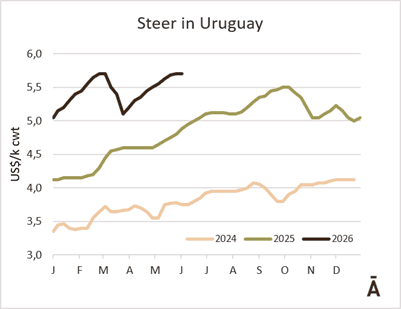
In this environment, the market continues to show a wide range of prices, with differences of more than 10 cents per kilogram between top-end and standard cattle.
According to market sources, heavy steers are trading between US$/kg 5.55-5.70 carcass, while cows are quoted at US$/kg 5.25-5.40 carcass. Heifers remain one of the most sought-after categories, with prices ranging from US$/kg 5.50-5.65 carcass. “No one is talking about lower prices,” one operator said.
Business for feedlot placements continues, although many animals have not yet reached target weights. “Many lots are still 30 to 40 kilograms short of reaching 400 kg,” one operator explained.
Steers are trading between US$/kg 3.20-3.30 liveweight, whether destined for quota or non-quota programs, while heifers are quoted at US$/kg 3.00-3.10 liveweight. The source noted a strong preference for large, uniform lots with suitable feedlot characteristics in terms of age, weight, and carcass potential.
Meanwhile, live cattle exports continue to provide underlying demand, although activity is temporarily constrained by logistical issues.
“Feedlots are full because a vessel has not arrived. Apparently it is expected over the weekend,” the operator said. As cattle are released from quarantine facilities and previously purchased animals are loaded, he expects the market to regain momentum.